
Boxing/Unboxing In .NET
Originally published on my old blog at cumps.be on February 14, 2005.
In the .NET Framework there is a feature called boxing, which goes hand in hand with unboxing. Boxing is an implicit conversion of a value-type to the object type. While this is a very nice feature when programming normal applications, this overhead becomes a big performance hit when working with algorithms that need to do lots of operations, such as path finding.
When you create a value-type, it’s originally placed on the stack. If you box this value-type, the required memory is allocated on the heap, the value gets copied and an object is placed on the stack, pointing to the boxed value on the heap.
Boxing an int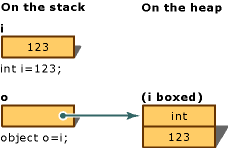
Unboxing the int again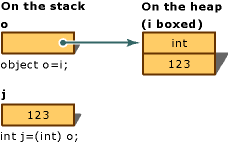
In a pathfinder I created long ago, in the .NET 1.1 era, a list of points had to be maintained. While this was possible using an ArrayList, it proved faster to write a typed list. The main reason behind this was because the ArrayList’s method signatures all work with objects, causing implicit boxing when using them. Retrieving items from an ArrayList also required unboxing, because that had to be cast back into their Point type.
I wrote a small application to demonstrate the boxing and unboxing taking place, and the performance impact. The test data were 10 million random Point values.
// Adding to an ArrayList
for (int i = 0; i < itemsToGenerate; i++) {
arrayList.Add(rndCosts[i]);
}
When we take a look at the IL code this piece generates, we would see the following:
ldobj [System.Drawing]System.Drawing.Point
box [System.Drawing]System.Drawing.Point
callvirt instance int32 [mscorlib]System.Collections.ArrayList::Add(object)
On the second line, you can see it uses the box operation to box our value-type Point (stored in the typed Point array rndCosts) before calling the Add method.
The solution to this is using generics, available from .NET 2.0 onwards, or writing your own typed list object. As .NET 1.1 had to be used, I chose the second solution. To do this, I used Reflector to look at the ArrayList code, and use that code to create a new list, replacing all instances of object with our required type, Point in this example.
Now we use the same piece of test code with our PointList.
// Adding to a typed PointList
for (int i = 0; i < itemsToGenerate; i++) {
pointList.Add(rndCosts[i]);
}
If we look at the IL this piece generates, we notice the following:
ldobj [System.Drawing]System.Drawing.Point
callvirt instance int32 [PointList]CumpsD.Collections.PointList::Add(
valuetype [System.Drawing]System.Drawing.Point)
The Framework does not use the box operation anymore, effectively getting rid of the overhead we had with our first solution. When we take a look at the test results, we can clearly see the difference between the first solution and the second.
ArrayList: added 10000000 items.
00:00:03.1845792 seconds
PointList: added 10000000 items.
00:00:00.2804032 seconds
By using the strong typed PointList it was possible to get just a bit more performance out of the code, making the project operate better in the long run. Just for fun, I revisited this test using .NET 3.5, with generics and created a List to store the items. I ended up having similar performance (00:00:00.2915599 seconds) as the typed list I created in .NET 1.1, pretty good considering I wrote it two years ago ;)
The main conclusion here is to avoid any non-typed collection when performance is an issue. Some browny points for our Bits & Bytes Religion when it comes to the happy feeling you get when working with generics :)



You May Also Like
Imagine Cup
Important note (to not get confused): The text below (and the future ones) is written in the past tense, because they are text that have to go into a book…
A* Algorithm
The A algorithm works with two lists, an open-list and a closed-list. The open-list is the list of nodes to be checked, while the closed-list already has…
Binary Heaps
A pathfinder has to be very fast, but when we take a look at the performance we notice that working with the open-list is the bottleneck.