

Day One
Originally published on my old blog at cumps.be on February 12, 2005.
The first task I got during my internship was to manage a meeting of the Microsoft Student Council. This was also the start of my internship, the real thing from the beginning.
The Microsoft Student Council is a Microsoft program aimed at students. Its goals are to support dedicated students who are willing to work with new technologies and are passionate about learning new things. Every student is able to join the council, without any costs. The only requirement is that students come to Microsoft, instead of Microsoft asking students to join. In other words, if you are motivated, you can be part of it.
The council organizes four meetings a year, each with a different theme. These students also get the opportunity to attend Microsoft seminars and to get involved in discussions with Microsoft developers. Nowadays there are about 100 students who are part of this council.
Besides organizing training and meetings, the Microsoft Student Council also tries to get students involved in various competitions and challenges, trying to spark the students’ interest in new things. This results in a good community feeling among the students involved, teaching each other new things.
On 11 February 2005 the second meeting took place, with Digital Entertainment as its theme. Due to an unexpected absence of the person organizing it, I was assigned to manage this meeting during the day.
In practice this meant I had to provide the required information for everyone on the SharePoint site used by the council, provide a route description, act as a contact person for the speakers, welcome everyone to the meeting, close the meeting at the end and make sure all speakers kept to their assigned speaking times.
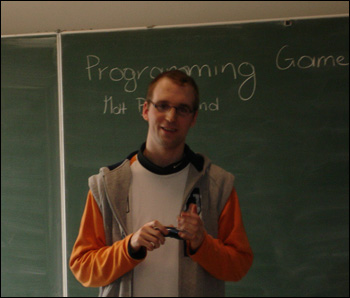
I was also a speaker myself during this event. My talk was about Game Programming: AI in Games, in particular about the A* pathfinding algorithm and using a binary heap as data structure.
Pathfinding is very important in gaming; because it is used a lot, it has to be as fast and efficient as possible. A good pathfinder can be used to calculate distances as well.
For navigation, the A* algorithm is used to find the shortest path.



You May Also Like

A* Algorithm
How the A* pathfinding algorithm works: the open and closed lists and the F, G and H scores, demonstrated on a grid of pixels.

Binary Heaps
Speeding up A* by keeping the open list in a binary heap stored in an array, with add and remove in C# and timings against a sorted ArrayList.

Internship at Microsoft
The start of my Microsoft internship, and the blog category where I'll write about it.