
Mediargus Extranets
Mediargus, the Belgian press-monitoring company, put together press reviews and topic dossiers for companies and government services. From January 2012 to 2014, first at Mediargus and later through iFrameWorx, Geert Van Huychem and I built the extranet website those organisations read them on, and we onboarded each new client as Mediargus signed them. It grew to nearly thirty clients: companies such as Mobistar, Elia, Fluxys, Luminus, AG Insurance, Atos and Bayer, the cities of Aalst, Genk and Tienen, the provinces of Oost-Vlaanderen and Vlaams-Brabant, the Flemish Parliament, and several Flemish and federal government services.
One codebase, many clients. Every client got its own extranet at its own address, such as genk.mediargus.be or mobistar.mediargus.be, all running the same ASP.NET application. A configuration per client pointed it at that client’s own tables and switched features on or off: the daily press review and its history, dossiers, search, printing, downloads as PDF, RSS or XML, and FAQ and about pages.
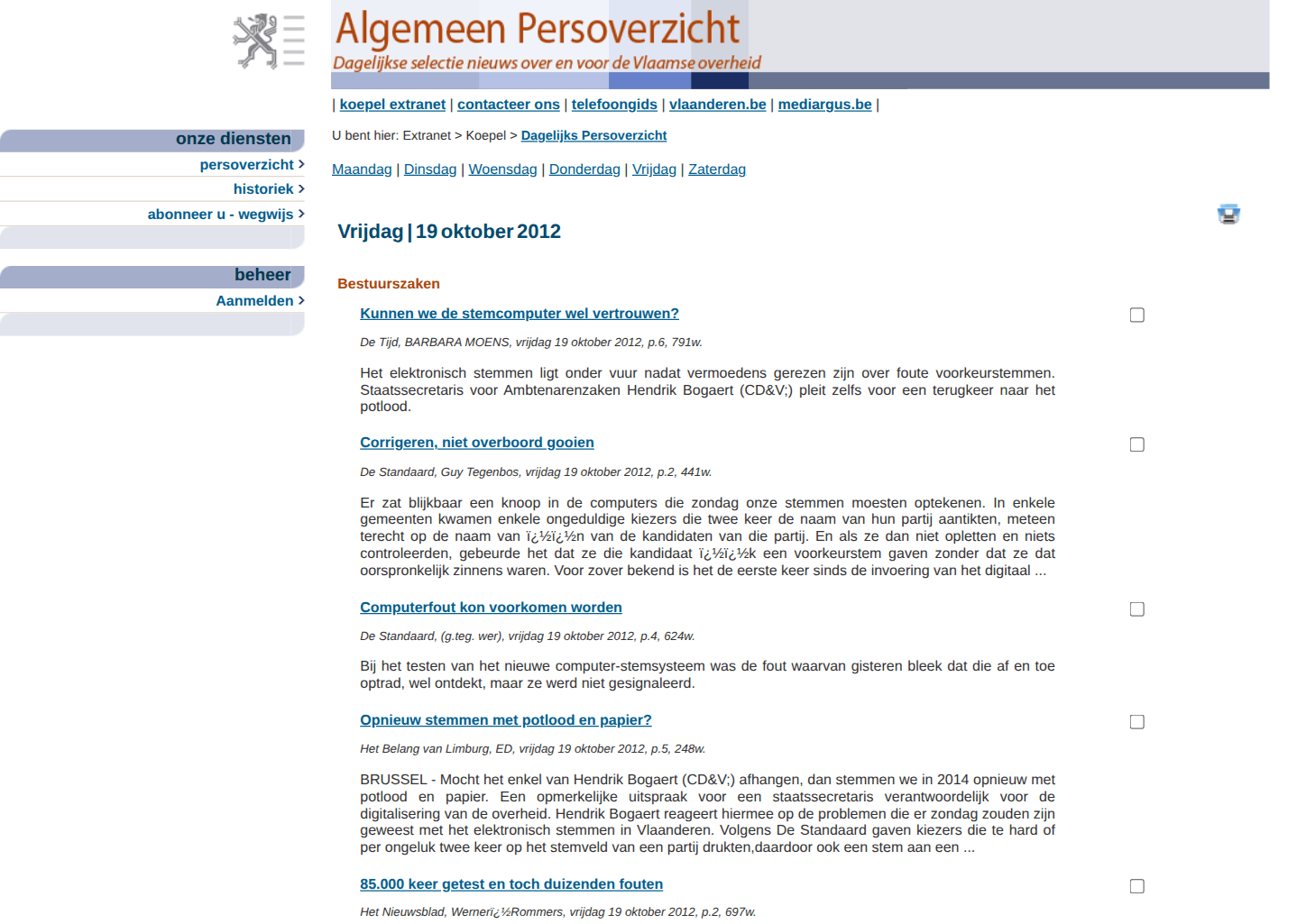
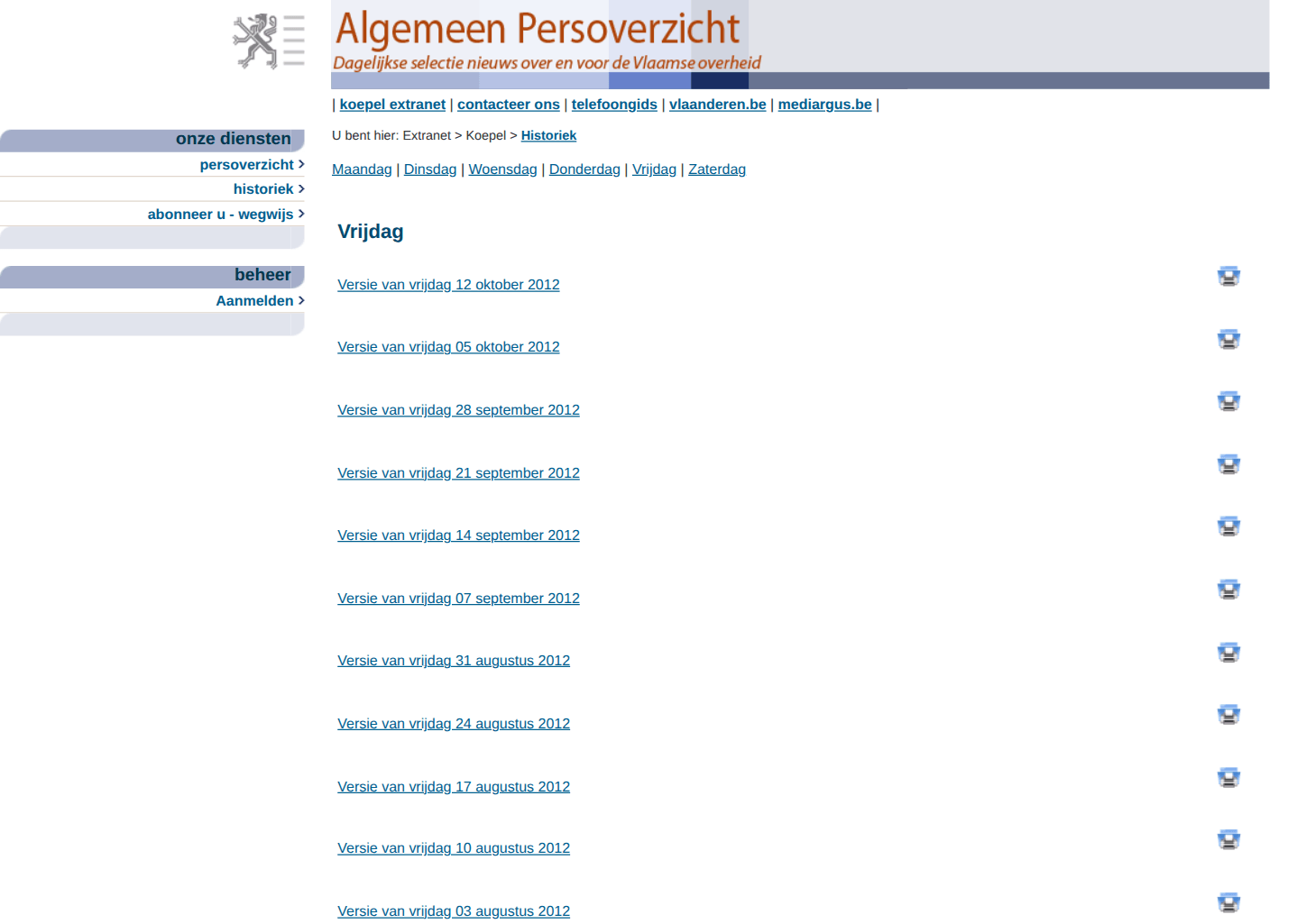
Branded to fit their intranets. Clients opened their extranet from their own intranet, so it had to look like part of it. For each new client we applied their branding: their own master pages, theme, scripts and images, and their own logo and copyright line on printed and saved reviews. For the Flemish government, at vlaanderen.mediargus.be, it became the “Algemeen Persoverzicht”, a daily selection of news for and about the Flemish government, in the government’s own house style and with links back to its intranet. The screenshots below are from the Internet Archive’s copy of that site, from October 2012.
What readers got. The day’s press review, with earlier reviews a click away, dossiers on a single topic, search across the articles, an article viewer, and a download basket to take articles along. The site spoke Dutch, French and English.
A mail in their own style. Each new review or dossier also went out by e-mail. Every client had its own HTML mail, built from its own XSLT with the images embedded in the message, showing an introduction, a table of contents and the articles as that client wanted, and sent in batches to the client’s contacts.
Running it. Administration pages let each client’s settings for reviews, dossiers, mailings and e-mail be managed, with logs and usage charts, and per-client scripts exported a client’s data when needed.
Technologies: C#, .NET Framework 4.0, ASP.NET WebForms, AJAX Control Toolkit, Castle ActiveRecord, MySQL, Oracle, memcached, XSLT, ZedGraph, log4net, Subversion, Assembla.


David is a great colleague to work with, packed with excellent coding skills in the .NET framework, but at the same time keeping an open mind, very pragmatic and a teamplayer. A real asset to my team.



You May Also Like

How This Blog Is Served
The machinery behind the words you're reading: Hugo, an unprivileged nginx, a strict CSP, and a deploy script.

Keeping the Old Addresses Alive
Nobody migrates email in one day. Fetchmail, a receive-only alias domain, and permanent redirects bridge the old world into the new one.

Making Roundcube Not Look Like 2012
Webmail is the face of the platform, so it got a Gmail-shaped skin, real calendar and contacts integration, and some money spent on polish.