
Broker as a Service
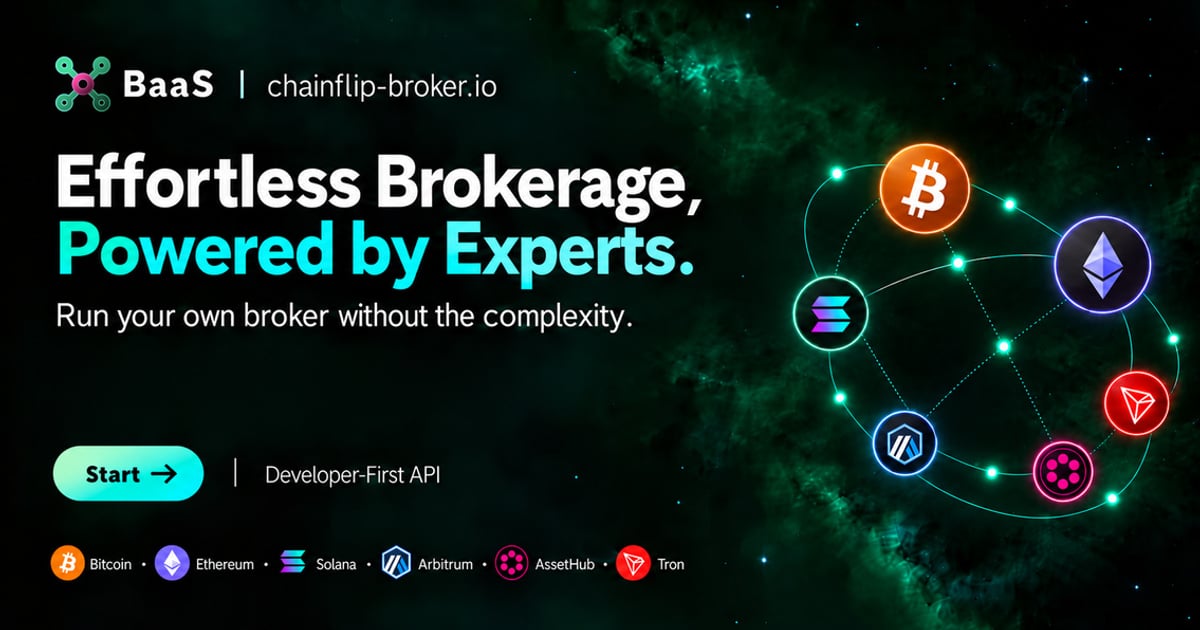
On Chainflip, every swap enters through a broker, and the broker earns a fee on it. Running a broker yourself means servers, load balancers, DDoS protection, protocol upgrades and someone who knows the stack. Broker as a Service (BaaS) operates that broker for you, so a wallet or DEX can integrate Chainflip swaps and set its own commission without running any of it. Wallets and exchanges such as ShapeShift, SubWallet, Cake Wallet and Babylon swap through it, and so does my own Swappy.
What integrators get. One API for everything a swap needs: quotes, including DCA swaps that split a large order into chunks and Boost for faster deposits; swaps through deposit addresses or vault swaps on Bitcoin, Ethereum, Arbitrum, Solana, Polkadot Asset Hub and Tron, with fill-or-kill refunds and slippage protection; and status, history and a live feed of swaps. Teams already using the Chainflip SDK can point it at BaaS as a drop-in RPC endpoint. BaaS enforces the integrator’s commission on the server, so users can’t strip it from a swap. Chainflip lists BaaS on its ecosystem page, and the documentation covers registration and the API.
Integrations on the other side. I also wrote a good part of the wallet side. In ShapeShift’s web app I added DCA swaps, the BaaS API key and minimum swap amounts to its Chainflip swapper and fixed its quote times and Boost fees (2024), and later added TRX and USDT on Tron there and in ShapeShift’s OG app (2026). I added Chainflip to Cake Wallet as an exchange provider in 2024, then moved it to new endpoints and added more assets, among them wBTC, USDT on Solana and Arbitrum, and Tron. In 2025 I switched Talisman’s Chainflip swaps over to BaaS, and in 2026 I added in-popup swaps through the broker, with Tron, to the Chainflip Quick Swap browser extension.
Partners and payouts. Registration is self-service and free: a partner gets an API key and its own affiliate account on Chainflip. Earned commissions are paid out automatically every hour, and BaaS reconciles every withdrawal against the broker and affiliate accounts. Completed swaps are announced on Discord and Telegram.
Built for AI agents. BaaS exposes a remote MCP server at chainflip-broker.io/mcp, listed in the official MCP registry, so AI agents can list assets, get quotes, start regular and DCA swaps, and track their status. Agents find their way in through llms.txt, an API catalog and an onboarding document written for them. The server definition and an agent skill are open source.
How it runs. The backend is .NET 10 and ASP.NET Core with PostgreSQL and Redis, the partner dashboard is React, and the documentation is Docusaurus. It runs on Kubernetes with Helm: two API replicas in production next to its own Chainflip nodes, and a separate environment on Chainflip’s Perseverance testnet. It’s also reachable as a Tor onion service, from an image I build myself. Logs go to Seq and metrics to Prometheus, every upstream provider sits behind a circuit breaker, and database migrations roll out without downtime. Builds and deployments run on my self-hosted Forgejo Actions.
How it’s built. More than 2,100 commits since February 2024, and about 2,200 automated tests. Development follows a story-driven workflow with AI coding agents and adversarial reviews, with me deciding what ships.
Technologies: C#, .NET 10, ASP.NET Core, Entity Framework Core, Dapper, PostgreSQL, Redis, React, Vite, Tailwind, Docusaurus, Chainflip (state chain RPC, broker API, SDK), Model Context Protocol (MCP), Kubernetes, Helm, Docker, Tor, Seq, Serilog, OpenTelemetry, Prometheus, Forgejo Actions, Renovate, xUnit, AI coding agents.



You May Also Like

The Family Vault: Vaultwarden
A Bitwarden-compatible password manager on the platform: split routing around end-to-end encryption, and the honest state of the rollout.

One URL for Everything: the Family Dashboard
The family dashboard, the fastest epic of the project, and container status tiles without handing anyone the Docker socket.

How This Blog Is Served
The machinery behind the words you're reading: Hugo, an unprivileged nginx, a strict CSP, and a deploy script.